


Our doctor is here to help you with guidance and general inquiries.
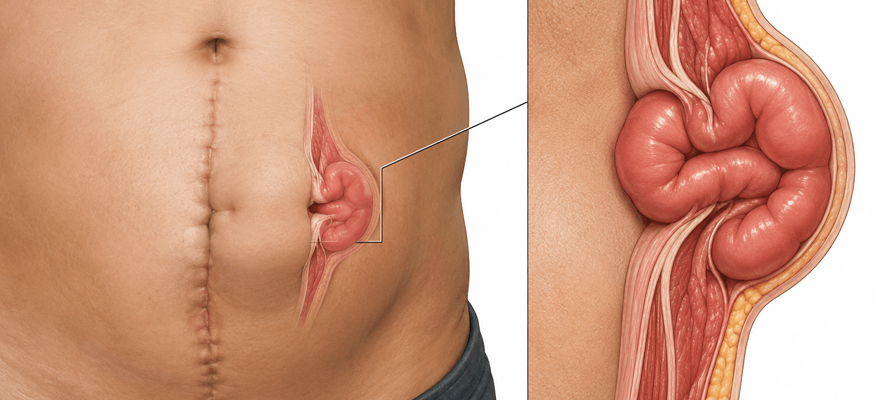
An incisional hernia develops when abdominal tissue or bowel protrudes through a weakness in the abdominal wall at the site of a previous surgical incision. It is a recognized complication of abdominal surgery and can range from a small, asymptomatic bulge to a large, symptomatic hernia requiring surgical correction.
Following abdominal surgery, the wound in the abdominal wall is closed with sutures. In some patients, this closure weakens over time or fails to heal adequately, creating a defect through which abdominal contents can push. Factors that increase the risk include:
Surgical repair is generally recommended for symptomatic incisional hernias or those that are enlarging. Small, asymptomatic hernias in patients unfit for surgery may be managed conservatively with abdominal support and monitoring.
Incarceration (trapped hernia) or strangulation (compromised blood supply) are serious complications requiring urgent surgical intervention.
The hernia defect is exposed through a surgical incision, the hernial sac is reduced, and the defect is repaired with mesh reinforcement. This is often the preferred approach for large or complex incisional hernias.
An IPOM (intraperitoneal onlay mesh) repair may be performed laparoscopically for suitable hernias, placing mesh over the defect from within the abdominal cavity. This approach may reduce wound complications at the hernia site in selected patients.
For large midline incisional hernias, component separation techniques allow the abdominal wall muscles to be mobilized and brought together without excessive tension, often combined with mesh reinforcement.
Clinical examination is usually sufficient for diagnosis. CT scan may be used to assess the size, content, and complexity of the hernia, particularly for surgical planning.
Recovery after incisional hernia repair varies depending on the size of the hernia and the technique used. Activity restrictions, wound care guidance, and follow-up appointments are provided individually for each patient.