
Our doctor is here to help you with guidance and general inquiries.
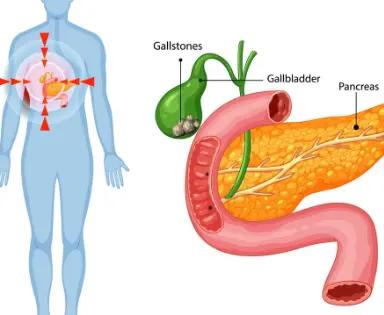
The liver, gallbladder and pancreas sit close together in the upper abdomen and share common drainage paths that unite them. Because of this, a problem in one organ can cause pain, jaundice or vomiting that seems to come from another. A gallstone can cause pancreatitis, and a blocked bile duct can affect the liver. This is why these organs are treated together by a hepatobiliary and pancreatic (HPB) surgeon.
Dr Annagiri Raghavendra is a liver, gallbladder and pancreatic surgeon in Ballari and a Consultant Surgical Gastroenterologist with over ten years of surgical experience after his MS. He treats patients with disorders of the liver, pancreas, gallbladder and biliary system, from routine to complex conditions, at Sri Raghavendra Health Centre. You can read his full background on the About page.
The liver produces bile, which travels through the bile ducts, is stored in the gallbladder, and is released into the intestine near the opening of the pancreatic duct. So if any part of this system is blocked or inflamed, more than one of these organs can be affected.
A hepatobiliary and pancreatic surgeon in Ballari can see the entire situation. This is useful for you, because the symptoms you feel may not point directly to the organ that needs treatment.
Gallstones are often the main reason people are referred to a surgeon. They can lie silent for many years, or cause repeated pain in the upper right abdomen, often after oily meals and sometimes with nausea.
Dr Raghavendra treats:
In most cases, laparoscopic gallbladder surgery in Ballari through small keyhole cuts is the preferred treatment. Many patients leave hospital within a day or two. If the gallbladder is badly infected or you have had earlier surgery, open surgery may be the safest option, and Dr Raghavendra will explain why.
Bile duct problems may appear as yellow skin or eyes, dark urine, pale stools or itching. The causes can include stones in the duct, narrowing of the duct or tumours. Finding out the cause is important, because the treatment for duct stones is different from the treatment for tumours. A bile duct surgeon in Ballari first assesses your scans and blood tests before planning any surgery.
Not all liver problems need surgery, and many are best handled by a liver physician. When an operation is needed, a liver surgeon in Ballari has to decide whether a growth can be removed safely, how much healthy liver tissue would remain, and whether other treatments should come first. Dr Raghavendra makes these decisions after reviewing your scans and tests, and he will tell you if your problem is better handled by another specialist.
The pancreas lies deep in the abdomen, which makes its diseases harder to diagnose and its operations more difficult. A pancreatic surgeon in Ballari treats:
Most attacks of pancreatitis settle with hospital treatment and do not need surgery. Surgery is advised only for complications, for pain that cannot be controlled, or when a tumour must be removed.
Operations on the pancreas and liver are among the most complicated in abdominal surgery. Dr Raghavendra completed his MBBS in Mysore, his MS in General Surgery in Davanagere, and then his MCh in Surgical Gastroenterology in Jaipur. This last degree is focused training on the digestive organs, including the liver, bile ducts and pancreas.
These cancers usually show little or no signs in the early stages, so they are often found late. Dr Raghavendra carefully evaluates your scans and biopsy reports and plans surgery together with oncologists and other specialists, so that the operation fits your overall treatment plan. If you already have a diagnosis and would like a second opinion, he will review your reports. Read more about hepatobiliary and pancreatic cancer surgery.
Consult a surgeon if you have:
Sudden and constant abdominal pain, continuous vomiting, or yellow eyes with fever and shivering can be emergencies. Please go to the nearest hospital immediately.
Bring your ultrasound, CT or MRI reports, blood test results, past discharge summaries and a list of your current medicines. If you have had pancreatitis before, bring those records too. Together, these help Dr Raghavendra give you a clear opinion in one visit.
After laparoscopic gallbladder surgery, many people are back to light activity within a few days. Operations on the liver, bile ducts or pancreas are more complex and take longer to recover from. Before surgery, Dr Raghavendra explains the hospital stay, diet after surgery, activity limits, warning signs to watch for after you go home, and follow-up visits.
Not always. Stones that cause no symptoms are sometimes only watched. But stones that have caused pain, infection or pancreatitis usually need removal. A gallbladder surgeon in Ballari can advise after seeing your scan.
Yes. A stone can slip into the bile duct and block the pancreatic duct at its opening. This is one of the common causes of pancreatitis, and the gallbladder is often removed afterwards to prevent another attack.
Yes. The liver continues to make bile. A few people notice looser stools for a while, and most return to their normal diet over time.
No. Some growths are harmless and some are not. A liver surgeon in Ballari will look at the scan features and tests to find out which one it is before suggesting any procedure.
No. Most attacks settle with hospital treatment. Surgery is needed only for complications or for specific causes.
Yes. Dr Raghavendra is happy to review your reports for a second opinion before you decide.
More questions? See our full FAQs page.
Dr Annagiri Raghavendra
Sri Raghavendra Health Centre, C/O Amrutha Surgicals, Sajjan Arcade, Opposite SP Bungalow, Near SP Circle, Police Gymkhana Road, Ballari, Karnataka – 583102
Phone / WhatsApp: +91 98807 05522 | +91 91874 95573
Email: sriraghavendrahealthcenterbell@gmail.com
Get directions on Google Maps | Contact page
Please call or WhatsApp to confirm your appointment time.
This page is for general information and does not replace a medical consultation. Treatment depends on your individual condition.